
AI Business & Governance / POV
AI makes IT services more productive. Will it make them more profitable?
How generative AI changes delivery costs, pricing and value capture in IT services
On this page
For the last three decades, companies like Accenture, TCS, Infosys and Wipro have built large businesses helping enterprises develop and manage technology systems. Their advantage expanded from cost and access to engineers to engineering capabilities, domain knowledge and complex delivery. Generative AI could let them deliver the same work with fewer people in less time. If customers still pay for people and hours, that productivity may reduce revenue. Profitability depends on pricing, competition and how much of the savings customers negotiate away.
How IT services evolved into AI delivery
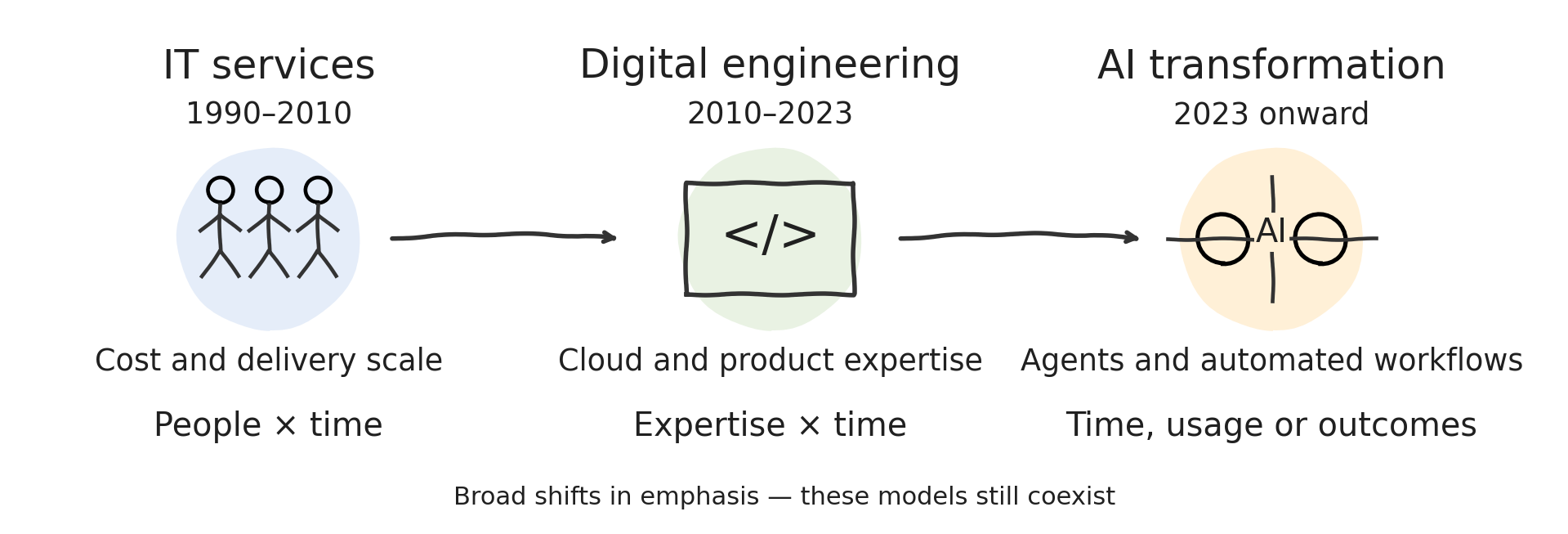
Companies like EPAM, Globant, Persistent and Thoughtworks built their positioning around stronger engineering and product development, but historically much of their revenue has relied on how many people were deployed and for how long.
With generative AI, established providers started building AI practices and adopting new tools. At the same time, products such as Cursor, Harvey and customer support agents offered a different way to buy technology. Customers could purchase software or automation of a workflow rather than the engineering capacity needed to build it. The companies building those products and the companies using AI to deliver services may benefit from the same progress in very different ways.
Will AI reduce IT services revenue?
Consider an illustrative software project requiring 20 engineers for six months. At $5,000 per engineer per month, the contract revenue is $600,000. Now suppose AI allows the same scope and quality to be delivered by eight engineers in four months. Under the same billing model, revenue falls to $160,000, a reduction of around 73%. These are assumed productivity gains to show how the billing works, not a forecast.
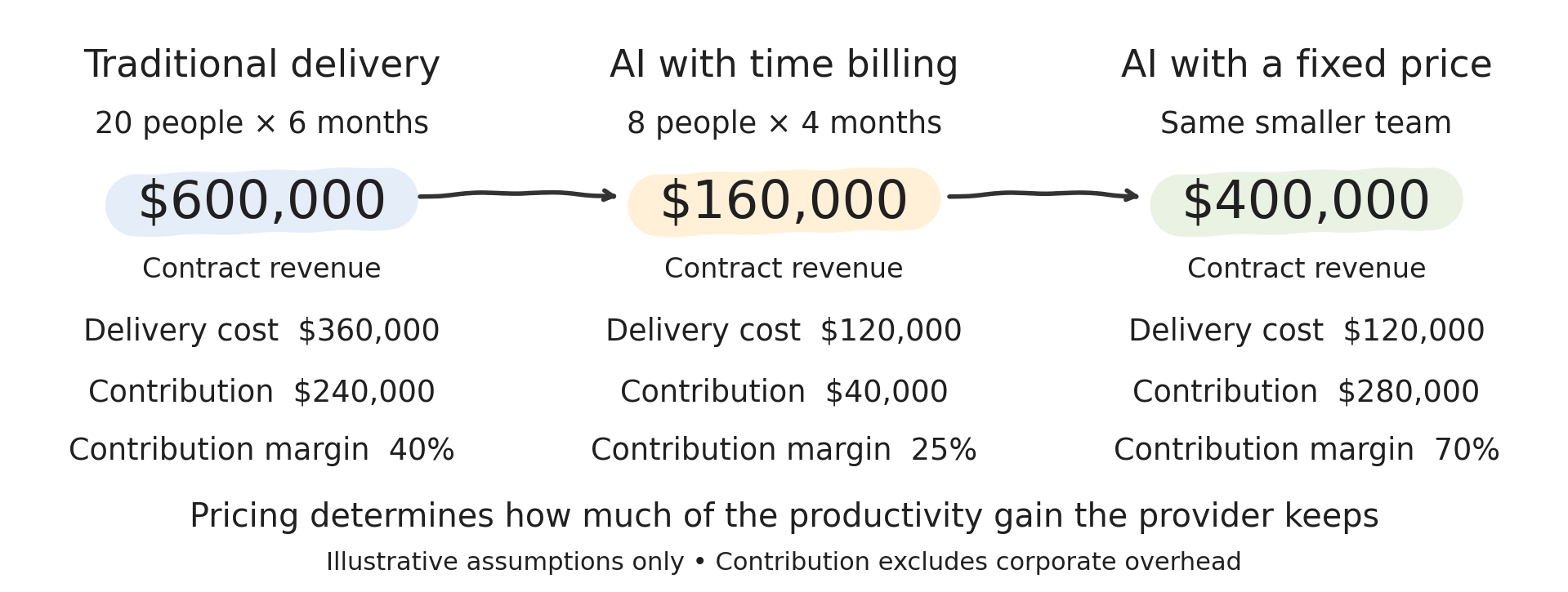
To look at profitability, assume an engineering cost of $3,000 per person per month, held constant for simplicity. In practice, senior, AI-fluent engineers may cost more. The original project costs $360,000 and contributes $240,000, or 40% of revenue. For AI delivery, engineering costs fall to $96,000. Adding an assumed $24,000 for incremental AI tooling and oversight brings delivery costs to $120,000. Under time billing, contribution falls to $40,000, or 25%. These illustrative assumptions exclude corporate overhead.
At a fixed price of $400,000, the same AI delivery contributes $280,000, or 70%, while saving the customer $200,000. Revenue falls, but absolute contribution rises. The result depends on the price the customer accepts: at $300,000, the margin would still be 60%, yet contribution would fall to $180,000. A higher percentage margin therefore does not automatically mean more money for the provider.
Time-and-materials pricing charges for effort. Fixed-price contracts charge for agreed scope, while outcome-based pricing links payment to a measurable result. Each changes who carries the risk. With fixed scope, the provider bears more overrun risk; with outcomes, it may also carry performance risk. Factors outside the provider’s control need to be agreed upfront.
Changing the commercial model also affects hiring, utilization targets, sales incentives and forecasting. Sales and delivery need shared assumptions about scope, effort and promised savings, with estimates they can check and a plan for handling overruns.
If competitors achieve similar productivity, customers may negotiate lower prices. To retain some savings, a provider needs something customers value enough to pay for: domain expertise, reusable technology, reliable execution or knowledge of their systems that is difficult to replace.
How AI changes competition in IT services
I initially thought digital engineering companies would be better protected because architecture and complex integrations still require strong technical capabilities. But if they sell those capabilities through engineers and hours, they face the same pricing pressure. The more useful distinction is between improving the existing delivery model and building a different one around AI. Engineering quality helps, but how the work is organized and priced matters just as much.
How does this show up in company results? Palantir is a product company rather than a services peer, and it reported 85% year-on-year revenue growth in Q1 2026. In its Q3 FY2026 results, Accenture reported 6% growth in US dollars and 3% in local currency. EPAM reported 4.5% revenue growth in Q2 2026. These are different businesses and reporting periods, so this is not a like-for-like comparison. It does show that strong demand for an AI platform can coexist with much slower growth in large services businesses. [1] [2] [3]
I would not conclude from these numbers that AI caused the slower growth, or that a faster-growing company is necessarily a better investment. Customer budgets, business mix and the size of the existing revenue base all matter. But the underlying question is useful. A product company may grow usage without adding employees proportionately, while a services company may need new work just to compensate for fewer billable hours on existing projects.
I am also interested in companies building enterprise delivery around AI from the start. These companies are competing for some of the same work as established service providers, but starting with smaller teams, AI agents and reusable delivery platforms. 8090 is an example. In March 2026, EY US announced EY.ai PDLC, powered by 8090’s Software Factory. That suggests the model can become part of an incumbent’s delivery capability, rather than only compete with it. [4]
Hang Ten Systems, led by former Infosys CEO Vishal Sikka, is another company worth watching. Its June 2026 announcement describes agentic code generation and a reusable skills library, and names Siemens Gamesa and Fresenius as customers. However, positioning and early customer announcements do not establish that the model can consistently deliver large, long-running engagements. Handling legacy systems, security requirements and contractual responsibility will matter as much as generating software quickly. [5]
There is also competition from the enterprise itself. Global Capability Centres, or GCCs, are enterprise-owned operations that build capabilities internally. The Nasscom–Zinnov FY2026 report identifies 2,117 GCCs in India, up 32% since FY2021. They help enterprises retain knowledge and control over their systems. AI could make some internal teams more productive and insourcing more attractive, although external specialists and flexible capacity will still be needed. [6] But service providers increasingly have to explain why the customer should buy the capability rather than build it.
The 8090 and EY partnership also shows how new delivery companies and established providers can work together.
Who will benefit from AI productivity gains?
AI-native products have their own problems. Consider Glean and Microsoft: Microsoft 365 Copilot Search already searches enterprise content across Microsoft and connected external systems. [7] A specialized search product has to justify its additional purchase through better results or a closer fit to the customer’s needs. That does not tell us who will win. But what the customer already uses, and how easily a new product fits in, matter alongside model quality. Platform providers, software companies and services firms increasingly compete for overlapping parts of that work.
Traditional service providers have advantages that are easy to underestimate. They know customer systems, have established procurement relationships and have experience keeping important applications running for years. A small team may demonstrate a working application quickly, but the customer still needs confidence in migration, maintenance and support. I do not think those requirements disappear because development becomes faster.
Firms with reusable delivery technology and deep knowledge of a customer’s business are better placed to retain productivity gains. Training employees on AI tools helps delivery, but does not by itself give customers a reason to pay more.
There is a reasonable possibility that lower development costs create much more demand. Enterprises have plenty of software and automation work that has been too expensive to justify. If AI makes that work affordable, providers could handle more projects even as effort per project declines. Whether the additional demand offsets lower prices and fewer billed hours is still an open question.
I would watch three signals over the next couple of years:
- Revenue per employee — is the company earning more from its delivery capacity? This needs to be read alongside outsourcing, acquisitions and business mix.
- Absolute profit and margins — is the provider retaining the savings, rather than just reporting a higher percentage margin on a smaller business?
- Customer acceptance of new pricing — are fixed-scope, platform or outcome contracts expanding in actual deals, beyond what companies announce?
Established providers have customer trust and delivery experience; new companies can design their operations around AI from the start. The question is whether either group can turn productivity into absolute profit after customers claim their share of the savings.
These observations use selected 2026 company disclosures and illustrative project economics. Company figures and commercial models continue to change.
Sources
- Palantir Q1 2026 business update — May 2026
- Accenture Q3 FY2026 results — 18 June 2026
- EPAM Q2 2026 filing — quarter ended 30 June 2026
- EY US and 8090 announcement — 18 March 2026
- Hang Ten Systems company announcement — 24 June 2026
- Nasscom–Zinnov India GCC Landscape Report — FY2026
- Microsoft Learn — Copilot Search and connectors — accessed October 2026