
Ontology / POV
What Is Ontology in AI? Giving AI Agents Business Context
What is ontology, where can a business use it, and how does it help AI? A practical look at shared meanings, connected information and business decisions.
On this page
We are giving AI access to more of our business. It can search documents, read emails and look up records. But I keep coming back to a question: how does it know what that information means in our company?
An experienced employee knows which deals belong in a sales review, what a customer was promised, and when a policy has an exception. When something is unclear, they know where to check.
When they use AI, they often explain these things in the prompt. The answer improves because they supplied the missing context. But what happens when someone else asks the same question without knowing what needs explaining?
Could we make some of this understanding available to the AI before the person asks?
This is where I find ontology useful. An ontology is a shared, written-down model of a part of the business. It describes the things that matter, what they mean and how they relate. It can also describe relevant rules and limits. How those rules are checked and enforced depends on the software using it.
The word may be unfamiliar, but the need behind it is something we can recognise in everyday work.
We have the information. Do we have the meaning?
Suppose a sales manager asks, “Which deals need my attention this week?”
The customer relationship system, or CRM, has deal values, stages and owners. An email contains a customer’s concern. Meeting notes record a promise to send a revised proposal. The team structure tells us which deals fall under this manager.
A person who knows the work brings these pieces together. They might notice that a deal looks healthy in the CRM, but the customer has been waiting for a proposal and is becoming frustrated.
Could AI reach the same understanding? It would need to know what counts as a deal needing attention. Does “no activity” mean nobody updated the CRM, or nobody spoke to the customer? If the owner has changed, who is responsible for the earlier promise?
Some answers come from structured data, such as dates and amounts stored in fixed fields. Others come from unstructured data, such as emails and written notes. The system needs to connect the relevant information and use the company’s meanings to interpret it.
Much of this understanding sits with the people doing the work, often called subject matter experts, or SMEs. Building an ontology means working with them to describe those meanings and relationships so they can be used again.
What would we actually write down?
For the sales question, we could start with the people and things involved, how they connect, and the conditions that matter. The diagram brings these parts together. Different tools may organise them differently.
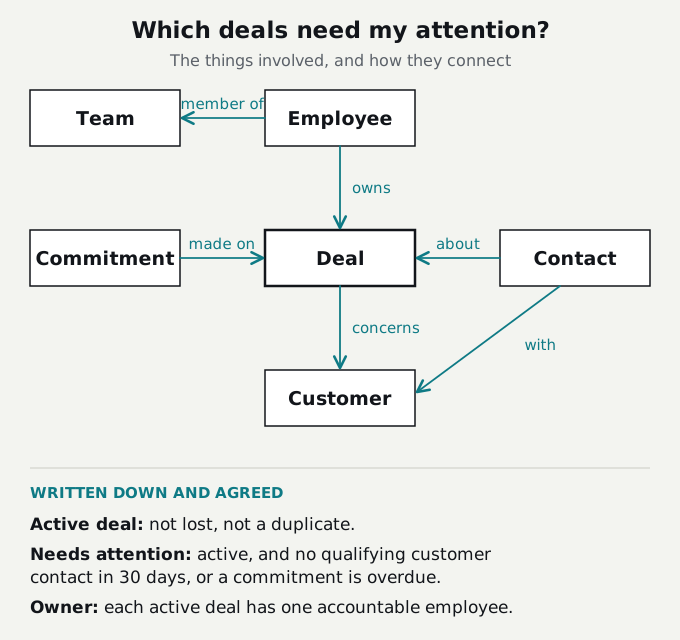
A deal’s value and stage are its properties. We also need to agree on the words we use. What makes a deal “active”? What counts as customer contact? Does an automated email count, or do we need a conversation?
AI can help us draft this model. The people responsible for the work need to decide whether it describes the business correctly.
Different companies may reach different answers. Even within a company, finance and sales may need different views of a customer. We can keep those views while making their meanings, and the links between them, clear.
Where could a business use ontology?
The sales example gives me one way to recognise a possible use: someone repeatedly has to bring information together and explain what it means before a decision can be made.
In sales, that could mean finding deals at risk. A deal’s stage tells us something, but customer concerns, missed promises and recent conversations may change the picture.
In customer support, it could mean deciding whether a refund is allowed. Imagine a washing machine arrives but fails during installation. Support promises a replacement, and the customer later asks for a refund. The order, technician’s report, replacement request and payment all belong to the same case. “Delivered” does not mean “working,” and “refund requested” does not mean “refund completed.” The system needs those distinctions and the relevant policy conditions. It still needs to check approval and prevent duplicate payments.
In purchasing and operations, the question could be, “Which customer orders might be delayed by this supplier problem?” To answer, we need to follow the connection from supplier to component, component to product, and product to customer order. We also need to check stock and expected delivery dates.
These are hypothetical uses. Whether an ontology is worth building depends on the problem and what the company already has.
Netflix offers a real example. Its engineers describe an operational ontology that brings together information about technical incidents and the services involved. They connect evidence from monitoring systems with conversations happening during an investigation. The useful lesson for me is that an alert tells us more when we can see which services are affected, who owns them and what changed. Those connections help people investigate; they do not prove the cause by themselves.
Google’s Digital Buildings project uses a shared model to describe buildings and installed equipment. Google says it uses a version internally to manage buildings in its portfolio. This helps applications work across buildings even when the equipment and source data differ. It also shows that ontology is useful beyond AI: people and other software need shared meanings too.
How much of the business do we need to model?
If relationships are useful, should we connect everything in the company?
I would start with the question we want to answer. In ontology design, these are called competency questions. They help us decide what the model needs to cover.
For our sales manager, we might ask:
- Which active deals under this manager have had no qualifying customer contact for 30 days?
- Who owns each deal now?
- Is there a customer concern or overdue promise that needs review?
Now we know why we need deals, owners, the team structure, contact records and commitments. Employee payroll details can stay outside this model.
We can add more when another question calls for it. We can also use these questions to check our work. Does the system find the right deals and exclude duplicates? What does it do when an owner is missing or it cannot confidently link an email to a customer?
How does the ontology reach the AI?
This is the next question for me. We have written down the business understanding. How does the AI use it?
For a small task, we might begin with a maintained document explaining the terms, relevant data fields, relationships and rules. The application gives the agent this guidance before it looks up the records. The document can guide its work, but cannot enforce the rules on its own.
The company may already have a semantic layer: shared definitions of business terms, calculations and relationships over its stored data. If it already defines an active customer or how revenue is calculated, we should build on that understanding.
Microsoft’s Fabric IQ ontology documentation describes how business definitions can be linked to data in its source systems. The product is documented as being in preview. The idea I find useful is that the model can describe the business while the records remain where they are.
The agent can then use the agreed meaning of “active deal,” find the relevant records and read the supporting notes. The application still has to connect the sources, match the correct records and check what the agent is allowed to access or do.
Do we always need a knowledge graph?
If some information is in databases and some is in documents, do we need to put it all into a knowledge graph?
That depends on the questions we need to answer.
The ontology describes the model: an employee owns a deal, and a deal concerns a customer. A knowledge graph holds connected facts: this employee owns this particular deal for this customer. It may use the ontology to organise those facts.
We could look up deals in a database and find the relevant emails when needed. If that works reliably, a separate graph may add little value.
A graph may help when we repeatedly need to follow several connections, such as tracing a supplier problem through components and products to affected customer orders. We should still compare it with what our existing systems can do.
There is another detail I would be careful about. An email saying a customer might cancel should remain a possibility, with a link to the source. Putting that information into a graph does not make it a confirmed cancellation.
How do we build a shared understanding?
The more I think about ontology, the more I see the need for people who understand the work.
Sales knows how deals progress. Operations knows which promises can be fulfilled. Finance knows what counts as an approved payment. Technical teams know where this information sits and how the systems represent it.
They may discover that they use the same word differently. If two teams disagree on what “resolved” means, AI needs a clear explanation of those meanings. More data alone will not settle the disagreement.
Someone also needs to keep the model current as policies, teams and systems change. We should check whether it helps with the actual work: finding the right records, catching conditions that were being missed, or reducing the time people spend explaining the context.
I do not think every AI workflow needs an ontology. But if we keep explaining the same business terms, relationships and exceptions in prompts, I would ask whether some of that understanding should become a shared model.