
AI Business & Governance / POV
What an AI-Ready/AI-Native Workforce Actually Looks Like
Why building an AI-ready workforce starts with redesigning workflows, not training people on tools, and what it means for engineers, managers, juniors and learning.
On this page
Most companies start their AI workforce programme with tools, licences and prompt workshops. I think that is the wrong starting point. I would start by looking at how the work needs to change, then train people for that work. This post is based on a talk I gave on building an AI-ready workforce, and covers what changes for roles, skills and learning.
Why did our business model have to change?
Like most IT services companies, our billing was built almost entirely on man-hours: more people, more hours, more revenue. In several pilot and production engagements, we have now seen delivery run at close to twice the speed, with savings that are reflected directly in client pricing at roughly half the cost. These are our observations across a limited set of engagements, not an industry benchmark.
Why does this happen? In these engagements, AI changed several parts of delivery: boilerplate, drafting, setup, testing and review. When the same outcome takes fewer human hours, we also have to rethink staffing and billing. I explored the pricing side of this in AI makes IT services more productive. Will it make them more profitable?
Why is AI different from earlier technology shifts?
We have heard “technology will transform work” many times. Industrialisation reduced the cost of physical power, computers the cost of calculation, the internet the cost of distributing information, and the cloud the cost of computing infrastructure. Generative AI is beginning to reduce the cost of certain kinds of cognitive work.
The change I am interested in is who does the deciding, and how. Traditional software executed rules that a human had defined. With generative AI, a human defines intent and constraints, and the system interprets, reasons, generates and acts, while the human supervises and validates.
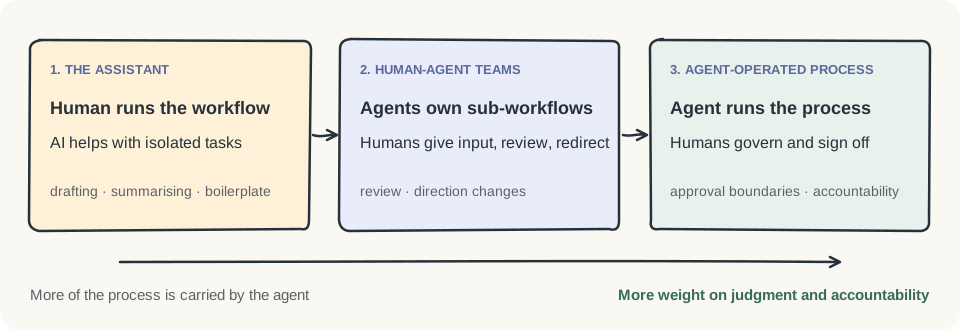
I see this as three stages:
- The assistant: the human runs the workflow and prompts the model for isolated tasks like drafting or summarising.
- Human-agent teams: agents own sub-workflows and come back to humans for inputs, reviews and changes of direction.
- Agent-operated processes: AI runs a multi-step process end to end, and the human role becomes governance and sign-off.
Should we ask which jobs AI will replace?
I think that is the wrong question. A job is a bundle of tasks, and AI usually automates, augments or accelerates specific tasks within it. Some human tasks become more valuable because the administrative noise around them goes away.
The Anthropic Economic Index shows how uneven this is: about 36% of occupations use AI for at least a quarter of their tasks, but only about 4% do so for three-quarters or more. It also found a rough 57/43 split between augmentation and automation. [1] That points to changes within jobs, rather than every task in a job being automated together.
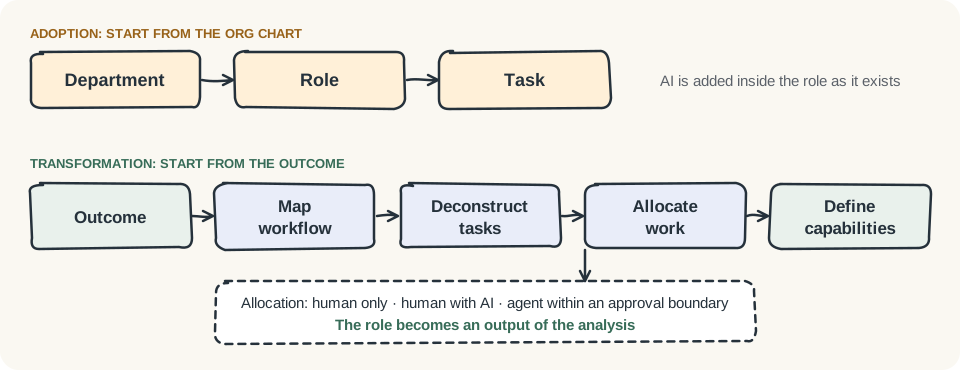
Adding AI to an existing role assumes the role should stay as it is. But should the same approvals, hand-offs and performance measures remain if agents take over some of the work?
Rather than start with departments and existing roles, I would:
- Identify the outcome and the business value required.
- Map the workflow as it actually happens.
- Break it into tasks.
- Decide what is human-only, human with AI, or AI-first within an approval boundary.
- Work out what people need to know and be able to do.
Then we can decide how to define the roles.
What happens to engineers and managers?
Software engineering makes this easy to see. The loop used to be requirement, coding, testing, pull request, review and bug fix. With copilots, the developer drafts boilerplate and tests with an assistant. In the emerging agentic loop, an engineer hands an issue to an agent, which explores the repository, writes and tests code, and a second agent reviews it before a human validates.
Producing code gets cheaper, but the hard parts remain. Someone still has to understand the problem, define constraints, weigh technical debt and security, and own the outcome. I do not think the engineer’s value simply moves from coding to prompting. It moves towards specification, architecture, evaluation, trade-offs and accountability.
That is also why productivity claims need care. Faster code generation does not necessarily mean faster delivery. Teams still need to understand the change, review the output, run tests and resolve failures. Whether AI helps depends on the task, the repository, the team’s way of working and the effort needed to verify the result. I would measure completed, accepted work rather than count how much code an agent produced.
Managers face a similar shift. They used to allocate work among people. Now they allocate it among people, models, agents, automations and APIs. The questions change too:
- Which tasks are safe to delegate?
- How do we evaluate agent work?
- Where must human checks sit?
- What failure rate is tolerable?
- Who is accountable when an agent gets it wrong?
Who creates the experts of 2035?
This is the part I find least comfortable. The tasks easiest to hand to AI, such as first implementations, initial research, data cleaning and first drafts, are the same tasks through which juniors learned. They also gave juniors a place to make recoverable mistakes and get feedback.
If AI takes over the beginner work, we may get more output now while giving juniors fewer opportunities to learn. There is an economic problem as well: firms hired juniors partly because their work was useful while they learned. If that work disappears, fewer juniors get hired just as they have fewer ways to develop. Everyone wants experienced, AI-native professionals, yet the system that produces them is weakening.
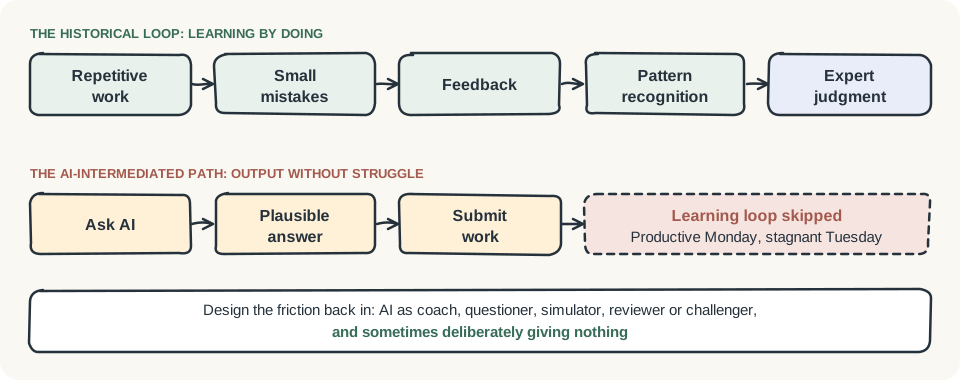
I do not think we have a clean answer yet. Stopping juniors from using AI preserves effort, not necessarily learning. Letting AI do everything preserves output, not capability. A more useful direction is to treat AI differently inside a learning system. Sometimes it should coach with hints instead of code, question in a Socratic way, simulate safe failures, review drafts or challenge design assumptions. Sometimes it should deliberately give nothing at all. We may need to deliberately create opportunities to attempt the work, make mistakes and receive feedback.
What does AI-ready actually mean?
Knowing how to write a prompt is a start. I think of readiness in five stages: awareness, literacy, fluency, collaboration and AI-native capability, which is the ability to redesign how work gets done when AI can do parts of it at low cost. People can be at different stages for different tasks.
The distinction I care about most is between knowledge, skill and capability. Take RAG:
- Knowledge: I know what retrieval-augmented generation is.
- Skill: I can follow a tutorial and build a basic pipeline.
- Capability: I can decide whether RAG is the right choice, design it within real constraints, evaluate its quality and operate it in production.
With AI, it is easy to mistake a good output for an understanding of how to produce it. Someone can produce a polished analysis or a working application without being able to explain its assumptions or recover when it fails.
As AI makes some tasks cheaper, I would pay more attention to the skills needed to direct and check them:
| When this gets cheap | This rises in value |
|---|---|
| Producing code, text and drafts | Evaluation and verification |
| Instant answers | Framing the right question |
| Implementation speed | Architecture and trade-offs |
| Raw content generation | Taste and discernment |
| Access to the same base models | Domain expertise and proprietary context |
Tools will keep changing. The skills underneath them are likely to last longer, and I group them into six areas: domain capability, AI literacy, AI collaboration, systems thinking, judgment and trade-offs, and accountability.
Where should an organisation start?
AI transformation cannot belong to one function, because the work crosses functions. Leadership decides where AI creates strategic advantage. Business leaders explain how work gets done. Technology and security teams provide the systems and controls. HR redesigns roles and talent pipelines. Learning teams build capability inside the flow of work, not in isolated classrooms. Managers redesign daily execution, and employees learn to collaborate with AI while staying accountable.
I would start with five steps:
- Define outcomes: the business value needed, not the tools.
- Map workflows: how the work actually happens today.
- Allocate tasks between humans, models and agents.
- Build capabilities: opportunities to practise and get feedback on the skills people still need.
- Measure and loop: check whether the outcome improved, then repeat as AI capabilities change.
I would judge readiness by whether a team can change its workflow, check that the change helped, and keep developing the people who do the work.
This post reflects my own observations and a talk I gave. The delivery speed and cost figures come from a limited set of our engagements and are not an industry benchmark.
Sources
- Anthropic Economic Index — occupational task usage and augmentation vs automation, 2025